In April, the UK government quietly revised its AI emissions forecast. Not by 10%. Not by double. By about 100-fold.
The Department for Science, Innovation and Technology had, in July 2025, projected AI data centre emissions peaking at 0.142 million tonnes of CO₂ in 2035. Under scrutiny from Carbon Brief and Foxglove, the figure was updated to 34–123 million tonnes across the decade to 2035. As a direct consequence, the original number had to be withdrawn, yet described as under 'routine review'.
Discovering a hundredfold error is a blunder. Describing it as routine review is another.
The more interesting story is not the correction. It is the structure that made it possible.
"Two UK government departments — one responsible for making Britain an AI superpower, one responsible for meeting its climate targets — were working from incompatible assumptions about how much electricity AI data centres would use. Two strategies. One grid. Completely different numbers."
One department's AI compute roadmap targets at least 6 gigawatts of AI-capable data centre capacity by 2030. The other's energy modelling projected commercial services sector growth of 528 megawatts over the same period. The gap between those two numbers is not a rounding error. It is a governance failure.
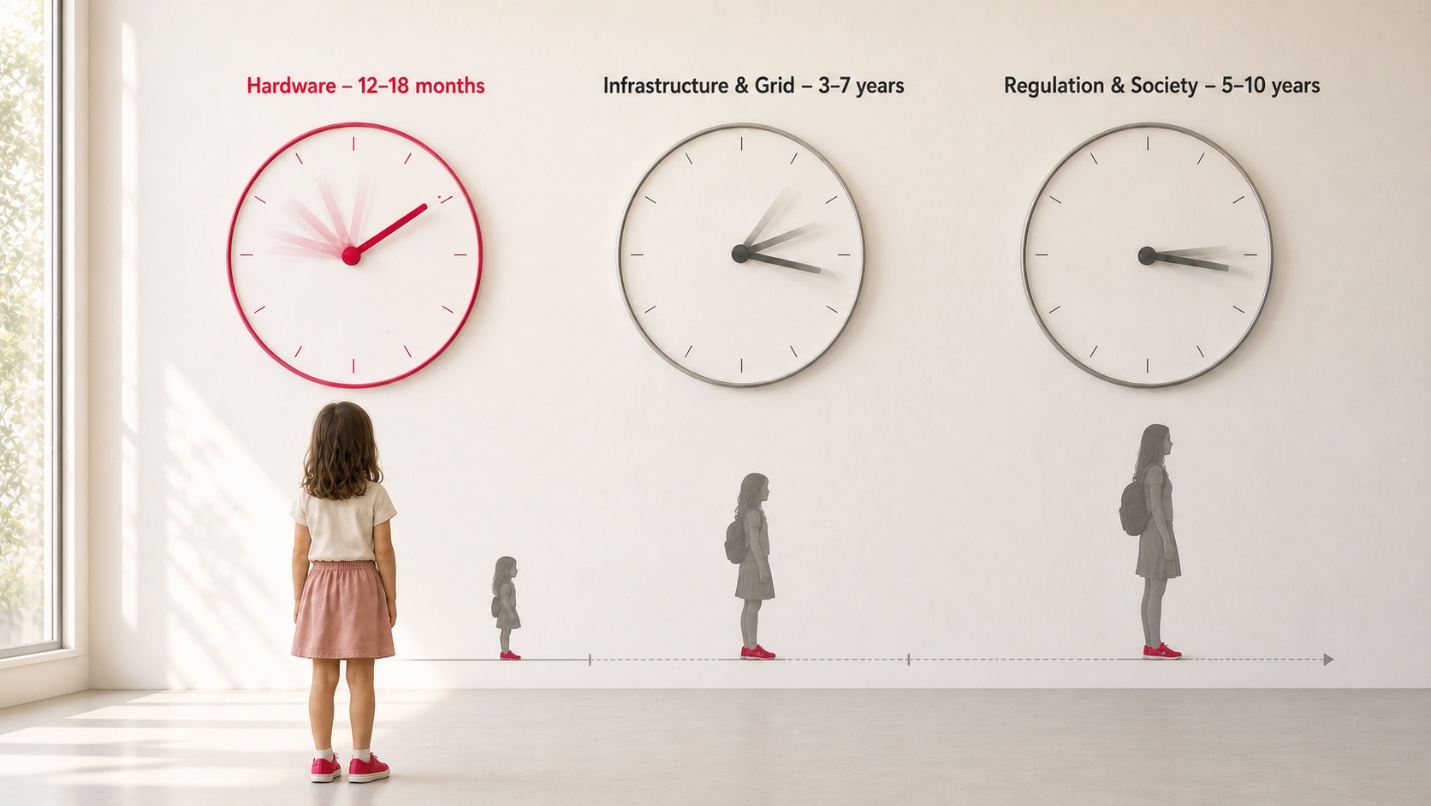
Three Clocks, Three Speeds
This is not a uniquely British problem. It is a structural problem that any organisation building an AI strategy will encounter. Most are not designed to resolve.
AI infrastructure operates across three systems running at fundamentally different speeds. The hardware frontier moves on 12 to 18-month cycles. Each GPU generation (H100, H200, Blackwell, Rubin) brings materially different power density, cooling requirements, and interconnect architecture. Semiconductor manufacturers publish roadmaps before the infrastructure to host them exists, creating manufactured urgency. The specification decision is being pulled forward deliberately by the companies that benefit from rapid adoption.
The infrastructure and grid clock moves on a 3 to 7-year cycle. Planning permission for a large-scale data centre in a constrained market runs to 18 months before a shovel enters the ground. Grid connections and generation assets take longer still. The design specification is frozen at the point of planning application. By the time the facility opens, the assumptions embedded in that brief (rack density, power draw, cooling approach) may no longer reflect what its first tenants actually need. Each 3–7-year infrastructure cycle spans three to five hardware generations. The data centre that finally comes online is already optimised for a previous wave of assumptions.
The regulatory and social clock moves on a 5 to 10-year cycle. Building codes, fire safety standards, electrical regulations: these were written for a world before AI infrastructure existed as a category. In several APAC markets, certification pathways for liquid cooling and high-density power simply do not yet exist. Regulators are not obstructing deliberately. They are applying frameworks that predate the problem they are being asked to govern.
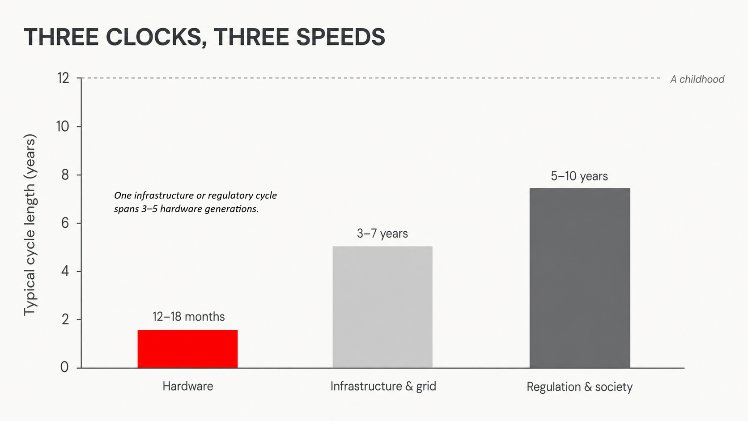
"If your AI strategy runs on hardware whose generations turn in twelve months, but your grid connection takes five years and your regulatory horizon is ten, you do not have a technology problem. You have a governance problem."
The Efficiency Argument Does Not Resolve It
There is a counter-argument worth addressing. The major semiconductor manufacturers (Nvidia, AMD, Intel, Qualcomm, Micron, Broadcom) all point to substantial efficiency improvements. AMD targets 30x node-level efficiency gains for AI workloads by 2025 and a further 20x rack-scale improvement by 2030. Broadcom claims 20–30% power reductions in networking infrastructure. These gains are real at the component and rack level.
They do not resolve the system-level problem. Global data centre electricity consumption grew 17% in 2025 despite those efficiency gains, with AI-focused facilities up 50% in a single year. The IEA projects total data centre consumption roughly doubling to 950 TWh by 2030, net of anticipated efficiency improvements. In Southeast Asia, data centre demand is projected to grow from 9 TWh in 2024 to 68 TWh by 2030, reaching up to 30% of national electricity demand in some markets.
More performance per watt is not the same as less power consumed. Model size and query volume are growing faster than chip efficiency. The denominator is outrunning the numerator. And the local ecosystems bearing the cost (stretched grid connections, water stress, land-use conflict, higher tariffs for everyone else) experience the aggregate, not the per-unit improvement.
What This Means for Financial Services Boards
The assumptions that make an AI strategy look coherent on paper are usually distributed across at least three separate functions: digital or data strategy, technology infrastructure, and finance or risk. Each function holds part of the picture. In most organisations, no one is mandated to reconcile them.
The assumptions are usually not wrong because someone is careless. They are wrong because no one asked the question that connects them.
For financial institutions, the consequences are specific. Regulatory obligations in markets including Indonesia, Singapore, Malaysia, and Hong Kong increasingly constrain where AI workloads can be processed and where data must reside. The infrastructure that satisfies those obligations (in-country or in-region, at AI-factory power quality) is not yet available at scale in most of those markets. The AI strategy and the infrastructure reality are on different timelines. Most board-approved strategy documents do not acknowledge the gap.
The UK's 100-fold revision is not a warning about British government competence. It is a warning about the structural separation between technology ambition and infrastructure reality that exists inside almost every large organisation building an AI strategy today.
"The AI strategy that does not account for the infrastructure underneath it is not a strategy. It is a document."
Intelligence by design means treating the grid, physical, regulatory, and organisational, as a first-order strategic question, not a technical footnote. The question is not whether AI strategies need to account for infrastructure. It is whether the governance architecture of your organisation is designed to force that reconciliation before the strategy is approved.
In most organisations, it is not.
Sources
- DSIT, Compute Evidence Annex: changes corrected, GOV.UK, 23 April 2026. Original projection 0.025–0.142 MtCO₂ by 2035; revised to 34–123 MtCO₂ cumulative 2025–2035.
- IEA, Key Questions on Energy and AI, April 2026. Global data centre electricity demand up 17% in 2025; AI-focused up 50%. Central projection: doubling to ~950 TWh by 2030.
- AMD Sustainability Report 2024. 30x energy efficiency improvement for AI/HPC by 2025 vs 2020 baseline; 20x rack-scale efficiency target by 2030.
- Wood Mackenzie, Southeast Asia Data Centre Outlook, 2025. Power demand: 2.6 GW today to 10.7 GW by 2035.
- Carbon Brief, Josh Gabbatiss, 23 March 2026. Analysis that triggered DSIT's revision.