
Boards across Asia-Pacific are approving ambitious AI strategies. Most of them have not yet confronted the question that sits underneath those strategies: where does the power come from?
Not metaphorically. Literally. The data centres required to train, run, and scale AI systems are among the most energy-intensive infrastructure ever built. And across Asia-Pacific, the region where most of the growth in AI deployment in financial services is projected to happen, the electricity infrastructure to support that ambition is constrained, contested, or simply not yet built.
This is not a future problem. It is a present one. And for financial institutions building AI strategies across the region, it deserves a place in the board conversation, not a footnote in the infrastructure team’s work plan.
This piece does three things. It quantifies the power problem. It maps where the constraint is most acute across Asia. And it sets out what boards need to change in how they think about AI strategy as a result.
It treats AI not as an abstract capability, but as a concrete infrastructure problem: a question of whether the underlying power and grid architecture can bear the weight of the strategies being written on top of it.
The Scale of the Demand
The numbers that have emerged in the past twelve months are significant enough to reframe the conversation.
Global data centre electricity consumption grew 17% in 2025, according to the IEA, well outpacing global electricity demand growth of 3%. AI-focused data centres grew faster still: up 50% in a single year. The IEA’s central projection sees total data centre consumption roughly doubling from 485 TWh in 2025 to 950 TWh by 2030, with AI-focused consumption tripling in the same period.
The five largest technology companies (Amazon Web Services, Google, Meta, Microsoft, and Equinix) spent more than 400 billion dollars on data centre infrastructure in 2025. That figure is projected to rise by a further 75% in 2026.
The critical distinction is not just quantity but quality. AI data centres, what the IEA now calls ‘AI factories’, with operational requirements that differ materially from conventional facilities. They require power quality that exceeds the technical capability of many developing-market grids. Load profiles are highly variable: AI training workloads create rapid, large swings in demand that stretch both grid connections and on-site generation to their limits. Cooling requirements at current rack densities demand water access and thermal infrastructure that land-constrained urban markets struggle to provide.
Across Asia-Pacific, that growth hits a much tighter physical ceiling than most board presentations admit. AI-driven data centres are pushing regional power demand up faster than new, high-quality capacity can be brought online, especially in grids that were never designed for large, variable, always-on digital loads. The result is a widening gap between the AI strategies boards are approving and the electricity systems that are supposed to power them.
The Asia Constraint Map
Singapore: the model — and the ceiling
Singapore has been managing this tension longer than any other market in the region. Data centres consumed approximately 7% of the city-state’s electricity before the government imposed a moratorium on new construction in 2019. The moratorium lasted until 2022, when a selective pilot programme allowed limited new capacity under strict sustainability criteria.
The latest iteration, DC-CFA2 (launched December 2025), makes the model explicit: government selects which projects proceed; operators must source at least 50% of power from approved green energy pathways, achieve a 1.25 PUE at full load, and meet stringent economic-contribution criteria. The programme covers approximately 200 MW of new capacity. AWS has pledged SGD 12 billion by 2028. Google committed USD 5 billion. The application deadline was extended twice before closing in April 2026.
Singapore is demonstrating that sustainability requirements and AI infrastructure growth can coexist. It is also demonstrating that this coexistence requires political will, regulatory architecture, and capital commitments that most markets in the region are not yet in a position to replicate. Singapore is the model. It is also the ceiling.
Malaysia: significant pipeline, constrained delivery
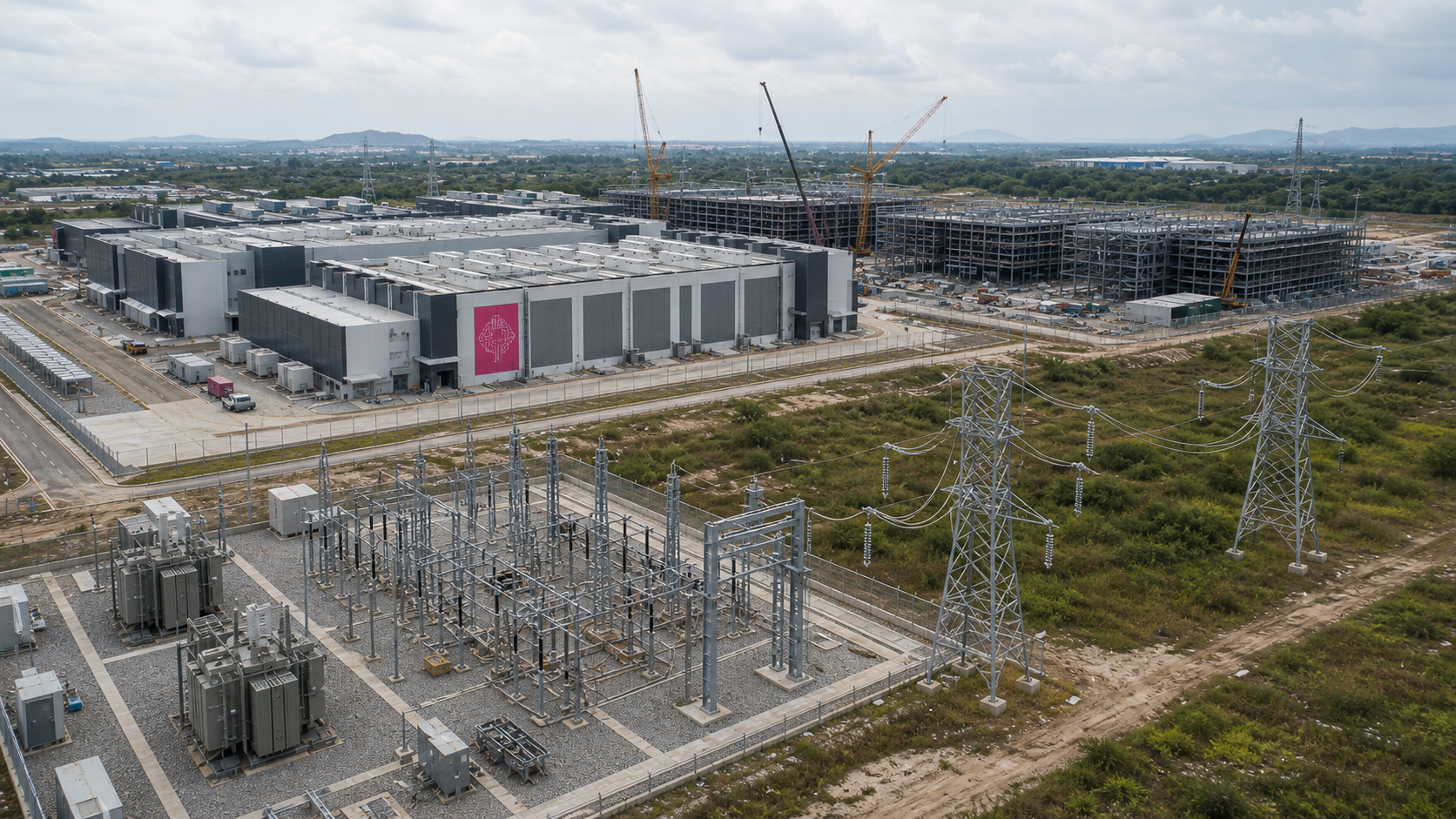
Malaysia emerged as one of the fastest-growing data centre markets in Asia-Pacific, drawing major commitments from Google, Amazon, ByteDance, Nvidia, Alibaba, and others. A substantial pipeline is underway across Johor and Selangor. The challenge is not a lack of ambition or investment. It is the gap between announced capacity and operationally available capacity.
By mid-2024 an informal moratorium on approvals had taken effect. Parliamentary data from November 2025 showed declared data centre capacity running at only 47% utilisation against maximum demand, not because workloads are absent, but because approved sites cannot yet secure reliable grid connections at the quality AI workloads require. Johor has stopped approving new Tier 1 and Tier 2 facilities over water constraints. Selangor has introduced a 30% local content requirement.
Data centres could require 5 to 6 gigawatts of electricity by 2035, roughly one-fifth of Peninsular Malaysia’s current total power capacity. For banks and insurers planning regional AI hubs here, the risk is a multi-year lag between AI roadmaps and grid readiness.
Japan: sovereign AI infrastructure, at cost
Japan has approached the problem as a matter of industrial policy. In April 2026, Microsoft announced a USD 10 billion investment in Japan for fiscal years 2026 to 2029, more than tripling its 2024 commitment, with SoftBank and Sakura Internet as key domestic infrastructure partners. SoftBank has acquired the former Sharp manufacturing plant in Sakai, Osaka, converting it into a large-scale AI data centre facility targeting 150 to 250 MW of capacity. The government is actively locating data centre capacity near offshore wind and nuclear generation sites.
The infrastructure logic is sound. The timeline is measured in years, not quarters, and the scale of coordination required is beyond what most markets in the region can replicate.
Indonesia, India, Thailand, Vietnam: the next wave
The next wave of investment is heading toward markets where land, energy costs, and regulatory frameworks appear more permissive. Microsoft has committed USD 17.5 billion to India through 2029. AWS has pledged USD 5 billion to Indonesia. Vietnam has drawn more than USD 7 billion in AI data centre commitments in 2025 alone.
According to Wood Mackenzie, data centre power demand across Southeast Asia is projected to grow from 2.6 gigawatts today to 10.7 gigawatts by 2035, a fourfold increase. Deloitte projects that Asia-Pacific data centre electricity consumption could exceed 1,000 TWh by the mid-2030s. The investments will come. The buildout will take longer than the AI strategies that depend on it.
The Real Risk: Not Oversupply, But Stranded Capacity
Taken together, the regional picture points toward a two-tier system. A small number of markets will be able to host AI infrastructure at scale because they can deliver sufficient, reliable, and increasingly low-carbon power; a much larger group will, for the foreseeable future, mostly consume AI services hosted elsewhere. Many current AI roadmaps in financial services implicitly assume the first reality while operating in markets that are structurally closer to the second.
In parts of the United States and Europe, analysts are debating the risk of data centre oversupply. In Asia-Pacific, the evidence points in a different direction entirely.
The principal risk here is not a classic glut. It is capital flowing into sites that cannot secure enough low-carbon, high-quality power or timely grid connections. Malaysia’s 47% utilisation rate against declared capacity illustrates this precisely. The IEA estimates that approximately 20% of planned data centre projects globally are at risk of delay from grid constraints alone.
For financial services institutions, the question is not whether AI infrastructure will eventually be built across Asia-Pacific. It will. The question is whether it will be available, at the quality required, in the specific markets where regulatory obligations require it to be located — and on a timeline that matches the AI deployment roadmap.
What This Means for Financial Services
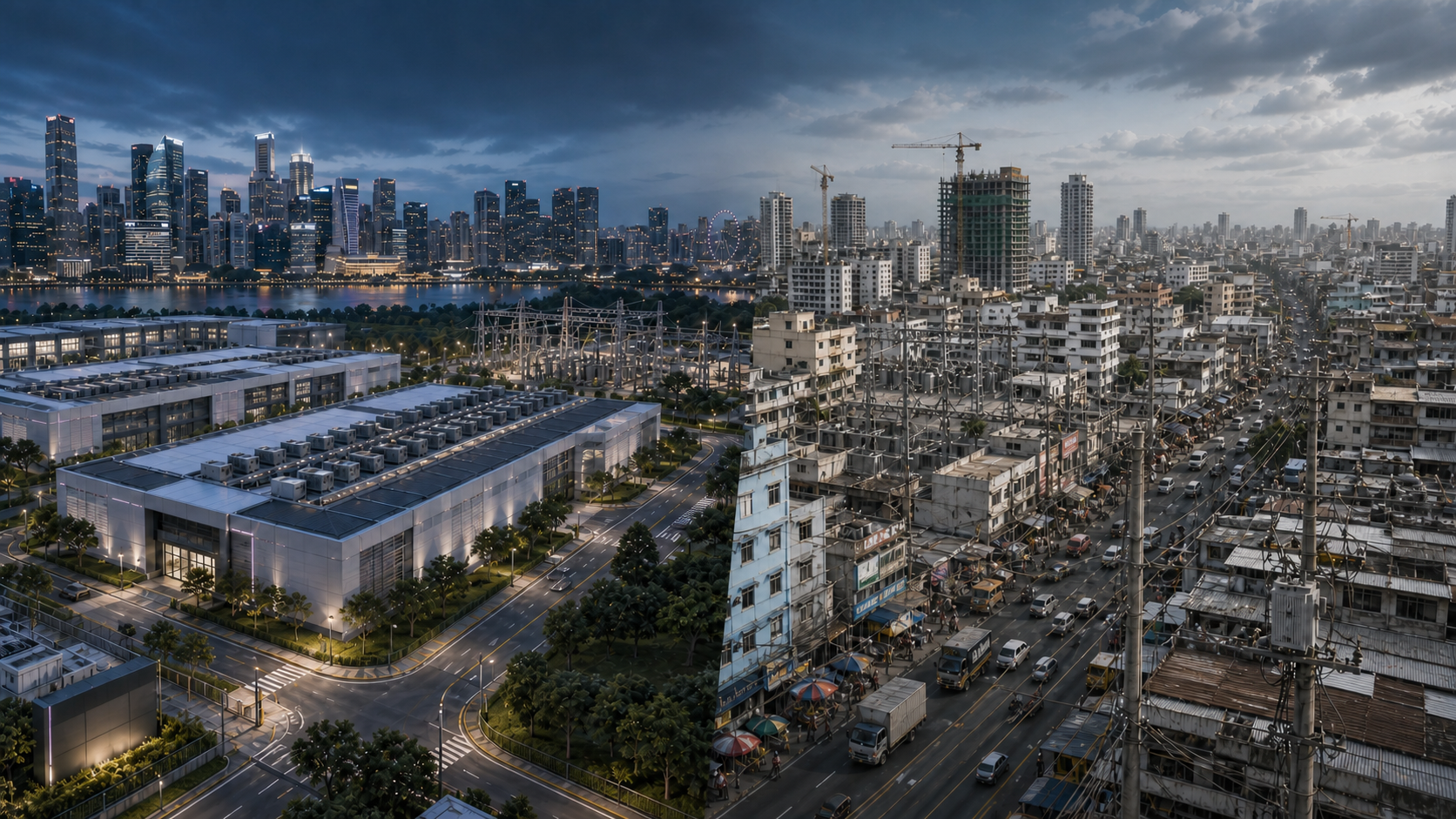
Technology will help, but not fast enough to remove the constraint. Efficiency gains, smarter use of existing infrastructure, and new deployment models can reduce the power required per unit of AI capability. But they do not change the basic reality that electricity systems upgrade on multi-year timelines, while AI strategies are being revised on an annual cycle.
The infrastructure constraint is not an abstraction. It has direct operational and strategic implications across four dimensions.
Latency and reliability. AI inference at scale requires data centre proximity to the point of decision. A model running in Singapore cannot always serve a real-time credit decision in Jakarta at the latency profile regulators and customers expect. Boards should be asking for a map of critical AI workloads by market against available in-market infrastructure.
Data governance and regulatory compliance. Financial-sector data frameworks across APAC increasingly constrain where AI workloads can be processed. Indonesia’s OJK Regulation 11/2022 mandates that banks locate both data centres and disaster recovery centres within Indonesian territory. Singapore’s MAS, Hong Kong’s HKMA (Practice Guide updated January 2026), Malaysia’s BNM, and Thailand’s BOT impose outsourcing notification requirements and cross-border transfer restrictions that effectively push AI infrastructure toward in-country or in-region deployment. The availability of compliant infrastructure is not keeping pace with the regulatory expectation that it exists.
Carbon accounting. Financial institutions with net-zero commitments face growing scrutiny on Scope 3 emissions, including emissions from cloud and AI infrastructure consumption. In markets where data centre power remains coal-heavy, the emissions exposure from AI deployment is material.
Vendor concentration. The concentration of AI infrastructure in the hands of five hyperscalers creates a dependency dynamic that most financial services risk frameworks have not yet fully assessed. Third-party risk frameworks will need to treat AI infrastructure concentration in the same way they treat critical market infrastructure and cloud resilience today.
Asia-Pacific is where the next decade of growth in financial services AI will be won or lost. The region’s financial institutions have the ambition, the capital, and increasingly the regulatory frameworks to deploy AI at scale. What most of them do not yet have is an honest account, in the board-approved strategy documents, of the infrastructure timeline, the cost, and the risk that makes those strategies real.
The power problem is being solved, market by market, at significant cost and over multi-year timelines. The question for boards is not whether it will be solved. It is whether their AI strategies were written with the solution in mind.
Most were not.