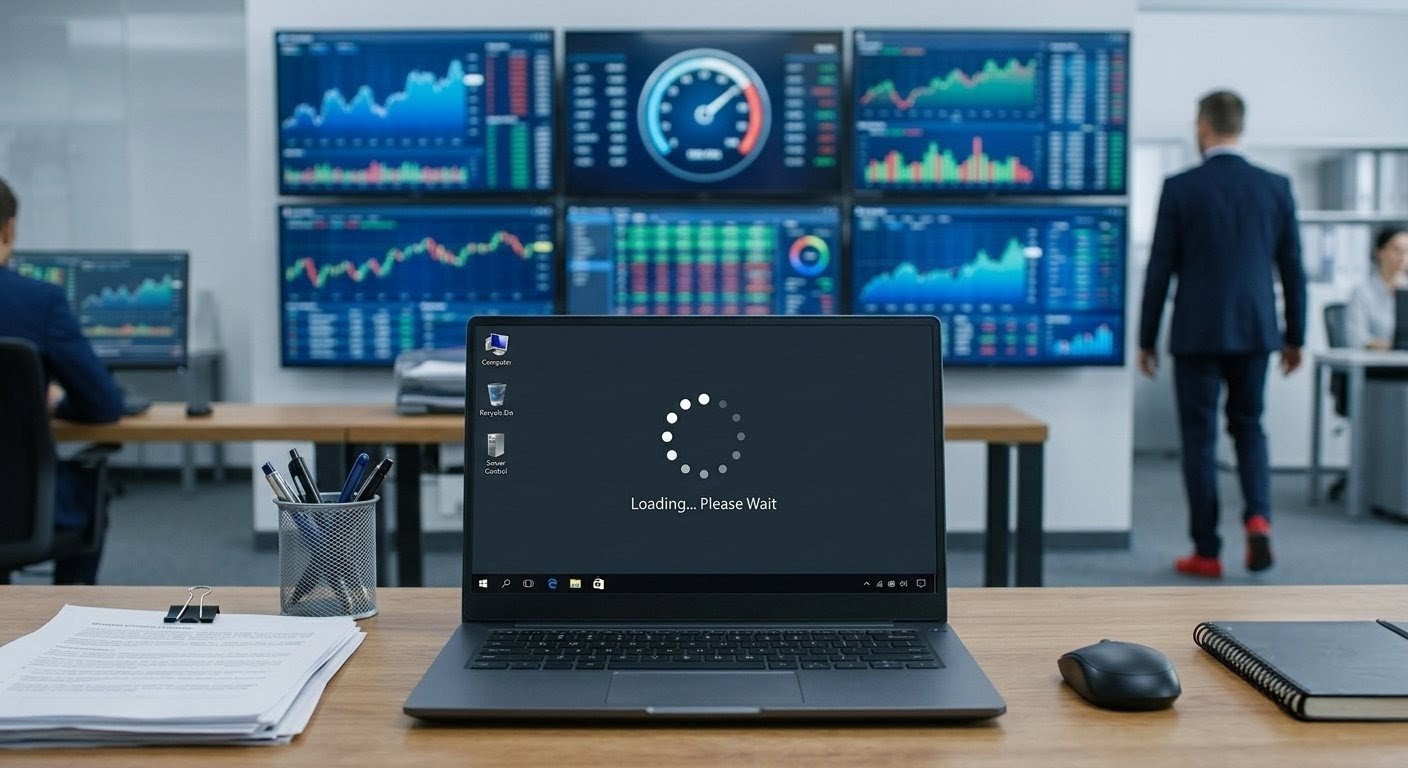
Somewhere in your organisation, a laptop is sitting on a desk. It was procured three years ago, during a refresh cycle that nobody connected to the AI strategy being written at the same time in a different building by different people. It runs Windows 10, or a version of Windows 11 that predates the requirements for AI capability. It has 8 gigabytes of RAM. It has no neural processing unit.
The person sitting in front of it has just been told that the organisation is deploying AI.
This is not a story about technology failure. It is a story about what happens when strategy and operations are managed as if they belong to different organisations, because in most large financial services groups, they effectively do.
The Hardware Reality
On current estimates, only a low single-digit percentage of the global installed PC base in 2023 qualified as AI-capable. In other words, four out of five devices on desks today are likely not AI-capable by current standards. The minimum specification for on-device AI, as defined by Microsoft's Copilot+ standard, requires a neural processing unit capable of at least 40 trillion operations per second, 16 gigabytes of RAM, and 256 gigabytes of storage, or better. Gartner projects that roughly a third of PC shipments in 2025 will be AI-capable. IDC estimates that AI-capable devices will be almost universal in the installed base only by 2028, on their definition of AI-capable PC.
The refresh cycle is the mechanism that makes this structural rather than temporary. The average enterprise laptop refresh cycle runs to three to four years. In financial services, where compliance lock-down, application validation, and regulatory requirements slow procurement, the cycle is typically four to five years. A device purchased in 2023 will sit on a desk until 2027 or 2028. By the time the AI roadmap reaches implementation, the organisation is locked into a device fleet that predates the assumptions in the strategy deck.

The Room Where It Was Decided
The hardware gap is real. But the more revealing question is how it came to exist.
In most large financial services institutions, AI strategy is developed by a combination of digital leadership, senior management, and external advisers. The output is a document: a vision, a roadmap, a set of use cases, a projected return on investment. It is presented to the board. It is approved.
The people who manage the device fleet are not in that room. They sit in technology operations, or in IT procurement, or in a shared service centre that reports to a different executive. They are measured on cost per device, refresh cycle adherence, and security compliance. They are not measured on AI readiness. Nobody asked them to be.
If you read the AI strategy deck and the device procurement policy side by side, you will often find they do not reference each other at all. The word 'laptop' does not appear in the AI roadmap. The word 'AI' does not appear in the device standard. In board papers, AI is discussed in terms of use cases and value. Device refresh is discussed separately in budget lines and risk papers. The two conversations rarely land in the same agenda item.
This is not negligence. It is structure. The organisation is layered in a way that slows the conversations strategy depends on. The governance failure is simple: the people accountable for making AI work are not the same people accountable for buying the machines it runs on, and they rarely share a decision forum. The consulting firm that wrote the AI strategy did not audit the device fleet. The board that approved the roadmap did not ask what was sitting on the desks of the people expected to use it.
The Energy Consequence
There is a further dimension that does not appear in most strategy documents.
On-device AI processing is significantly more energy-efficient than cloud inference. Research from Stanford's Scaling Intelligence Lab suggests that, for comparable workloads, on-device inference can be roughly an order of magnitude more power-efficient than cloud inference once transmission and data-centre overhead are included. The efficiency gain comes not from the device silicon being superior, but from eliminating the transmission overhead, the cooling load, and the idle capacity that cloud inference requires.
Organisations whose device fleets cannot support local AI processing are structurally locked into the higher-energy cloud path. For a financial services group, this is not only an ESG or grid issue. It is a cost structure issue. If the device fleet cannot run AI locally, the firm is committed to higher unit-cost cloud inference for the lifetime of that fleet. Every AI query that could have been processed locally travels instead to a data centre, consumes cooling water, draws on grid capacity, and contributes to the infrastructure demand already straining power systems across Asia-Pacific.
Organisations that abstract the endpoint entirely via virtual desktops or desktop-as-a-service simply shift the hardware gap into the data centre and amplify the energy consequence. The device gap and the grid gap show up as the same problem at different scales. A claims desk in Kuala Lumpur sending its AI workload to a hyperscale facility in Johor or Singapore encounters the same transformer and substation that the region's grid constraint maps.
What This Means for Financial Services Leaders
A CFO or CIO might reasonably respond: we never promised on-device AI. Our strategy assumes cloud-based AI accessed through the browser. Device NPU is optional. That is a legitimate position for some workloads. Optional is not the same as irrelevant. It becomes decisive when latency, privacy, or regulation make cloud routing a poor fit. In several APAC markets, regulatory obligations increasingly constrain where AI workloads can be processed. The device that cannot run AI locally is not a neutral choice. It is a constraint that narrows the strategy.
The question is not whether to refresh the device fleet. Most organisations will do so eventually, driven by Windows 10 end-of-support, security requirements, and natural procurement cycles. Approximately 240 million PCs globally cannot upgrade to Windows 11 at all, which creates a hard deadline that will force action.
The question is whether the refresh is being planned in connection with the AI strategy, or in parallel to it.
If your AI roadmap and device roadmap already share a governance forum, you are ahead of the market. The question then is whether the timing and scale of that refresh match the AI use cases you have promised. In most organisations, they do not. The AI roadmap has a timeline. The device refresh has a timeline. The two timelines have not been reconciled because the people who own them have not been in the same room.
The organisations that close this gap first will not do so by accelerating procurement. They will do so by changing who is in the room when the strategy is written. Technology operations, infrastructure, and procurement are not implementation functions that receive a finished strategy. They are strategic inputs that determine what is achievable and when.
The question worth asking before the next strategy review: does the person who owns the device fleet have a seat at the table? And if not, why not?
- Gartner, Forecast: PCs, Worldwide, 2022–2028, 2Q25 Update. Roughly a third of PC shipments in 2025 projected to be AI-capable.
- IDC, AI PC Installed Base Forecast, 2024. AI-capable PCs projected to be almost universal in the installed base by 2028, on IDC's definition of AI-capable PC.
- Canalys Research, December 2023. Approximately 240 million Windows 10 PCs cannot upgrade to Windows 11.
- Stanford Scaling Intelligence Lab, Intelligence per Watt (arXiv:2511.07885), November 2025. On-device inference roughly an order of magnitude more power-efficient than cloud inference for comparable workloads once transmission and data-centre overhead included.
- Microsoft, Copilot+ PC minimum specifications, 2024. NPU ≥40 TOPS, 16GB RAM, 256GB storage required for AI PC classification.
- Microsoft Work Trend Index, 2025. Just over half of workers report their current device is not suitable for AI use.